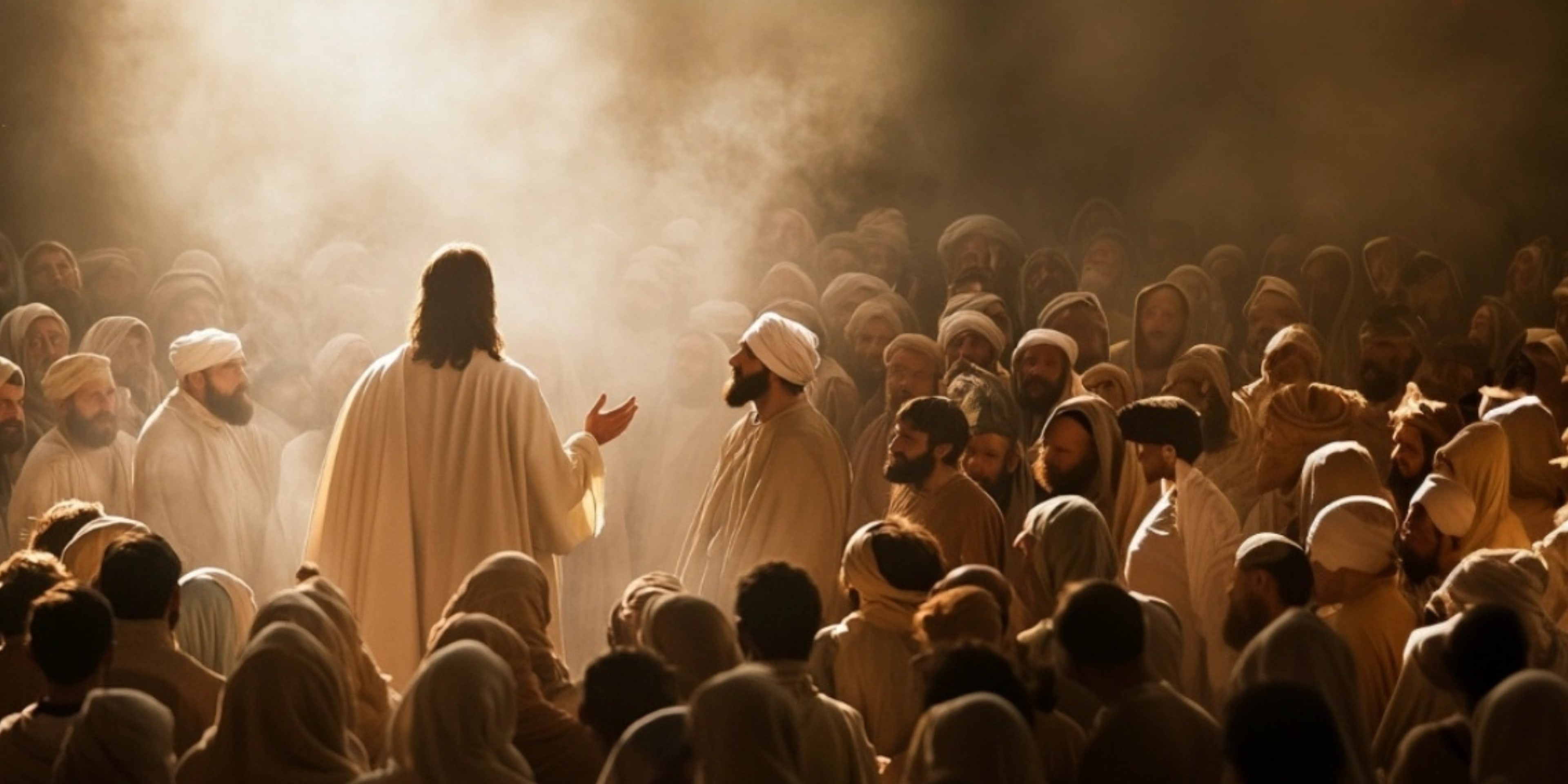
John 10:11 and 10:14 includes one of the most profound "I Am" statements made by Jesus:
"I am the good shepherd. The good shepherd lays down his life for the sheep."
John 10:11 CSB
This statement holds significance and symbolism that reveals key truths about who Jesus is, and how we can trust Him more because of His great love for us.
"1 'Truly I tell you, anyone who doesn't enter the sheep pen by the gate but climbs in some other way is a thief and a robber. 2 The one who enters by the gate is the shepherd of the sheep. 3 The gatekeeper opens it for him, and the sheep hear his voice. He calls his own sheep by name and leads them out. 4 When he has brought all his own outside, he goes ahead of them. The sheep follow him because they know his voice. 5 They will never follow a stranger; instead they will run away from him, because they don't know the voice of strangers.'"
The Sheep – John 10:1-5
In this illustration in John 10, Jesus depicts a larger courtyard or pen in which the sheep of several flocks belonging to different families are kept. In the morning, this shepherd goes down the street to gather the sheep. He would be recognized by the gatekeeper and granted access to the pen. The shepherd had a unique way of calling or whistling, sometimes using a small flute, that the sheep knew and obeyed. If multiple groups of sheep gathered at a watering place and mixed together, the shepherd could easily separate them again by using his call as he walked away. Some shepherds also gave their sheep names in addition to having their own special call for the sheep. No sheep would follow a different shepherd (indeed, they would flee anyone else), and no shepherd could lure or call sheep that did not belong to him. Sheep always go to the shepherd they know, who has cared for them, and flee anyone and anything else.
"7 Jesus said again, 'Truly I tell you, I am the gate for the sheep. 8 All who came before me are thieves and robbers, but the sheep didn't listen to them. 9 I am the gate. If anyone enters by me, he will be saved and will come in and go out and find pasture."
John 10:7-9 CSB
Jesus the Gate – John 10:7-9
What does it mean for Jesus to be "the Gate" in this metaphor? To grasp this, we need to take a deeper dive into the historical and cultural context. During summer, sheep might stay overnight in a pasture inside a simple pen made of stacked rocks. These pens, of course, had no roof or gate (in most cases), but thorny branches on top of the walls kept wild animals out, and the shepherd would sleep in the entrance to act as the door. That is, the shepherd would act as the gate with his body. Therefore, when Jesus called Himself the Gate, He was describing His role as protector (something He will elaborate on later in the passage with regard to His identity as the Good Shepherd). But in this text, He also adds something new: The sheep must enter and exit through Him (John 10:9). Jesus describes Himself as the exclusive means by which the sheep may enter the safety of the pen or pass into the provision of the pasture. Anyone who trusts in Him will experience safety, freedom, and supply.
"A thief comes only to steal and kill and destroy. I have come so that they may have life and have it in abundance."
John 10:10 CSB
Thieves and Robbers – John 10:10
In contrast with the shepherd who sleeps at the gate to give protection and provision for the sheep, thieves and robbers work to jump the pen and harm the sheep for their own gain with no real concern for the sheep. The shepherd's role includes defending the sheep from predators like wolves. Left to themselves, sheep are vulnerable, easily scattered, and unable to defend themselves. This abundant life is contrasted with what the thief brings: stealing, killing, and destroying. The thief acts selfishly and harms the sheep, but Jesus gives His life for the sheep to bring them life.
"11 'I am the good shepherd. The good shepherd lays down his life for the sheep. 12 The hired hand, since he is not the shepherd and doesn't own the sheep, leaves them and runs away when he sees a wolf coming. The wolf then snatches and scatters them. 13 This happens because he is a hired hand and doesn't care about the sheep.
14 I am the good shepherd. I know my own, and my own know me, 15 just as the Father knows me, and I know the Father. I lay down my life for the sheep."John 10:11-15 CSB
Jesus the Good Shepherd – John 10:11-14
What is it that makes Jesus the Good Shepherd? What qualities, characteristics, or behaviors does Jesus possess or perform that prove Him to be the Good Shepherd? There is one thing that Jesus states and illustrates repeatedly in John 10 that makes Him the Good Shepherd: He lays down His life for the sheep.
To help his doubting audience understand His identity and His purpose, Jesus contrasts Himself with a hired hand working with sheep. A hired worker may guard sheep for pay, but when danger approaches, like a wolf, they abandon the flock. Why? Because they lack ownership and genuine concern for the sheep's welfare. In contrast, Jesus, as the Good Shepherd, willingly lays down His life for the sheep. His love goes beyond duty or obligation—it is self-sacrificial.
As the Good Shepherd, Jesus invites us to trust Him with our lives. We are like sheep—prone to wander, in need of guidance, and vulnerable without Him. By recognizing His voice, following His lead, and embracing His care, we find abundant life. Jesus's sacrificial love, intimate care, and unwavering protection assure us that in Him, we are safe, loved, and never alone. Through this assurance, believers find confidence in their salvation. Jesus's power to lay down His life and take it up again guarantees eternal life for all who follow Him. His sacrifice and resurrection are the cornerstone of hope, showing that even death is under His authority.
To learn more about the "I Am" statements in John, see "The Gospel of John: I AM Statements" Bible Study.
See all of the "I Am" content below:
"I Am the Bread of Life": What Jesus Meant and Why It Matters
"I Am the Light of the World": What Jesus Meant and Why It Matters
"I Am the Good Shepherd": What Jesus Meant and Why It Matters
"I Am the Resurrection and the Life": What Jesus Meant and Why It Matters
"I Am the Way, the Truth, and the Life": What Jesus Meant and Why It Matters